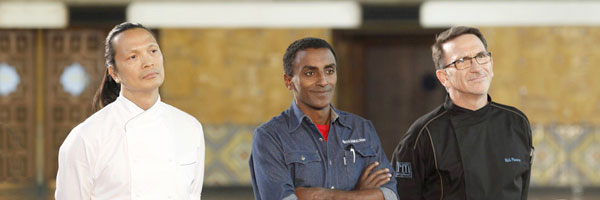
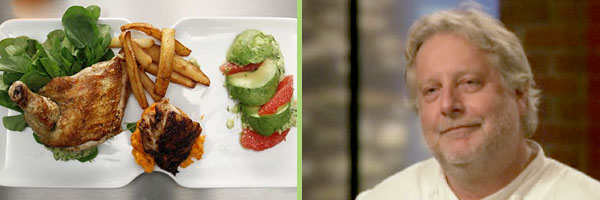
Rayner vs. Moonen
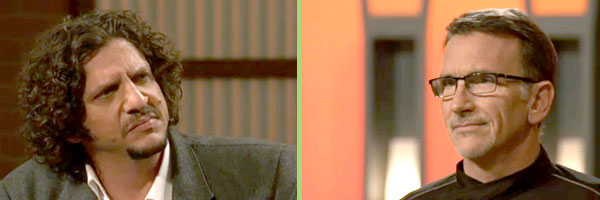
For those who might have missed it, the aftermath of the Top Chef Masters finale has been a little bloody. And not just in the typical "some fans are pissed" manner. It actually started at critics table, where Rayner questioned Moonen's use of New Zealand venison given his opinions regarding sustainability. The discussion... escalated... before ending up on the editing room floor. We know about it because Rayner told us about it on his Bravo TV blog, embarrassed that he'd lost his cool, but unashamed of the fact that he docked Moonen half a point for not following his own philosophy in a final challenge that was supposed to do exactly that. It didn't quite end there. An eater.com writer stirred the pot a bit, and now Rayner and Moonen are going directly at each other (though Rayner, at last check, insists he's done).
A popular take on the situation seems to be that Moonen was robbed and that Rayner destroyed the integrity of the judging process, but I think two questions are being conflated, here:
1) Did Rayner make the right judgment call?
2) Was it appropriate for him TO make that judgment call?
The first is a tough one. Is New Zealand venison sustainable? Was using it in conflict with Moonen's stated philosophy? Did he even know at the time? Does it matter in the context of Top Chef Masters? Did it matter enough to merit a half a star deduction? They're all good questions that have launched good discussions... none of which I intend to tackle here and now (though you're more than welcome to do so... keep it constructive, please!)
The second is the one that's frustrating me. It's being suggested that Rayner was out of line, that it was inappropriate for him to dock Moonen, that talking about it on his blog constitutes an "admission," and that the final result is illegitimate.
While I understand the frustration of those who feel this cost Moonen a victory (though I think there's a certain amount of speculation involved even in that claim), I find this maddening. Over eight seasons of Top Chef and Top Chef Masters, thematic challenges have been a mainstay. Of course, it's generally acknowledged that food comes before theme. As long as you keep a tenuous hold on the theme, cook great food and you're probably going to do fine. But if you drift too far from the theme, it's understood that you might get dinged for it. And contestants have been dinged for it. In fact, unscientific personal observation leads me to believe that people are more often frustrated when the judges are too lenient about a theme rather than too strict. But the point is that it's been firmly established that it's perfectly within the scope of their duties to take adherence to the challenge's theme into account when judging.
So let's look at this finale. It was not, as some seem to be unaware or are conveniently ignoring in the rush to savage Rayner, to simply cook the tastiest meal. Like any other thematic challenge on Top Chef, it was to cook the tastiest meal within a certain context, and that context was for the chefs to express themselves, their careers, their styles, their lives on the plate (I'm paraphrasing, here). Sustainability is a very, very big part of Rick Moonen's work as a chef. And that's Rick Moonen talking, not me. What we don't know is how frequently or how strongly Moonen touted that philosophy in six episodes leading up to the finale (he wasn't in three of the preliminary rounds). But let's say, for the sake of argument, that he made it a central theme of his experience as a chef.
Now take this hypothetical. Let's say one of those finalists was a vegan. And let's say that this chef had spent those six episodes cooking vegan meals and taking time at critics table to talk about how he felt it was wrong to exploit animals, and that cooking vegan food was incredibly important to him. And let's say that after being told the final challenge was to cook a meal that expressed who he was as a chef, made one of his courses a big honking T-bone. And let's say that after being asked about that choice, he said, "Hey, it's a cooking competition." How could one not conclude that he had simply flaunted the theme of the challenge?
I put this forth not to suggest that Moonen's transgression (if, indeed, there was one at all) was as serious, but simply to illustrate that there is a point at which a chef is brazenly flaunting the theme of the challenge and should probably be called on it and/or scored accordingly. You may not like that as a final challenge. You may want it to be a straight-up cook the tastiest meal possible challenge without any theme at all. But that's not what it was. Rayner didn't judge the challenge all of us would have liked him to judge. He judged the challenge the chefs were given.
Jay Rayner may or may not have made the right call. But he did the right thing in making it.